
Kathy Poehnert, MEd Psych, PCC. What Happens in Your Brain When the World has Done an About Face… And What to do About It.
As an executive coach helping clients navigate through the changes of the past 5-6 months, I initially helped clients address concerns around the drastic and immediate changes happening in their professional worlds (not to mention the fear and anxiety caused by the presence of a novel and unknown virus lurking out there). This concern manifested in uncertainty, confusion, and anxiety — for themselves, their families, and their teams.
Change is tough… It is, unfortunately, the only constant we can count on in life (aside, of course, from death and taxes). Change, especially when it comes quickly and unexpectedly can cause drama in the brain. The hippocampus — part of the limbic system in the brain which regulates emotional responses — comes into play when this type of change hits.
We are best able to manage and adapt to change when we can create new neurons (neurogenesis) in this region — because new neurons mean new and different neuropathways, hopefully ones that will help us manage this change. Unfortunately, if our negative experiences (those which we see as negative) out number our positive experiences (those we see as positive), the hippocampus can not function effectively, and depression and anxiety may result. These results certainly sabotage our performance in many minor, as well as major ways (“Trends in Cognitive Science.” Opendak and Gould).
Perception is the key word. Perception is the lens through which we see our world and it determines our emotional and behavioral responses… And it is very important when change hits.
Change, for most of us, is rather painful. Our brain becomes familiar with a certain way of perceiving and doing things — even though those ways may not even be the most efficient. I am sure we have all had a specific routine or process to achieve a desired goal, and even though we may be introduced to a new and better way of operating, we stick to our old patterns… Because they are familiar and comforting. Even though the rewards for changing may outweigh the risks of remaining the same, we tend to avoid the change at all costs, and keep our amygdala happy (the most reptilian part of the brain associated with fight, flight, or freeze). I remember reading a book by Bernie Siegal,MD, Love, Medicine, and Miracles, a surgeon at Yale who worked with many types of medical concerns. He spoke about the fact that a large majority of patients would rather go through dangerous surgery or take a pill to fix or alleviate their medical issue rather than change their lifestyle through diet, exercise, stopping smoking or drinking, or changing their mindset. Their lifestyle, however injurious to their health, was familiar… Change was the unknown and thus feared. Sometimes change does happen, but it will often take a serious or tragic event to kick the brain into change.
One of my favorite Anais Nin quotes expresses this so well: “And the day came when the risk to remain tight in a bud was more painful than the risk it took to blossom.”
While the current situation may not be tragic for many of us (although certainly for some who have experienced personal loss during this pandemic), it has certainly caused some immediate and drastic changes our brain has had to adapt to.
When the brain perceives change, it goes into protective mode, because change is seen as threat. The brain does not know if this change is good or bad, temporary or long-term. This uncertainty causes anxiety because it is not sure whether new patterns of behavior and new neuropathways need to be developed in order to feel more of a sense of certainty and predictability — which of course give us more of a sense of control.
When the pandemic first started, most of us had to adapt, and adapt quickly…Some more than others. For many in the corporate world, everything changed — from your morning wardrobe, coffee, breakfast, and commute routines to your interaction with your spouse, children and pets. All day… Let alone how you were going to find quiet space and time to manage teams and workload. So much happens in the brain when all these gears have to be shifted.
According to neuropsychologist Dr. Sanam Hafeez, the flexibility and malleability of our brain decreases as we age, and that is why change is often more difficult as we get older. When those ingrained neuropathways that bring us comfort, stability, and familiarity, can’t be used, we feel threatened. She suggests using “cognitive rehabilitation exercises” such as those found on Lumosity or BrainTrain. Of course these are best used in preparation for change, but most of us tend to be reactive rather than proactive. Still, keep this all in mind as I suspect change will continue to be a constant for us in the near future.
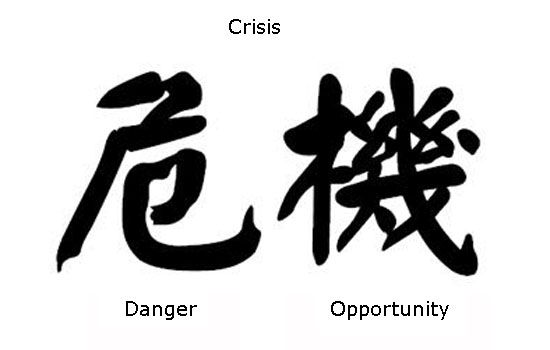 In working with clients, one of the approaches we took, was to reframe some of what was happening — to find the opportunity in this change. This helps to shift away from fear and into a more positive mindset, creating new neuropathways that become more ingrained when practiced. I reminded them that the Chinese character for crisis is made up of two characters: one meaning “danger” and the other meaning “opportunity.”
When Danger is the primary focus, the amygdala is triggered, and often hijacked. When this happens it is very hard to function, let alone lead. Our natural negativity bias leans towards threat, so we have to consciously disengage and train our brain to focus on opportunity.
One of the things several of my clients have discovered with this mindset is that some of the new patterns of thinking and behaving that have resulted from the pandemic lockdown have actually caused a rise in efficiency, productivity and connection! In fact, we have been pondering the question “Why go back to the old, when the new is working so well?”
Neuroscientist, Paul Maclean postulated the idea of the “Triune Brain,” composed of three parts:
In working with clients, one of the approaches we took, was to reframe some of what was happening — to find the opportunity in this change. This helps to shift away from fear and into a more positive mindset, creating new neuropathways that become more ingrained when practiced. I reminded them that the Chinese character for crisis is made up of two characters: one meaning “danger” and the other meaning “opportunity.”
When Danger is the primary focus, the amygdala is triggered, and often hijacked. When this happens it is very hard to function, let alone lead. Our natural negativity bias leans towards threat, so we have to consciously disengage and train our brain to focus on opportunity.
One of the things several of my clients have discovered with this mindset is that some of the new patterns of thinking and behaving that have resulted from the pandemic lockdown have actually caused a rise in efficiency, productivity and connection! In fact, we have been pondering the question “Why go back to the old, when the new is working so well?”
Neuroscientist, Paul Maclean postulated the idea of the “Triune Brain,” composed of three parts:
In working with clients, one of the approaches we took, was to reframe some of what was happening — to find the opportunity in this change. This helps to shift away from fear and into a more positive mindset, creating new neuropathways that become more ingrained when practiced. I reminded them that the Chinese character for crisis is made up of two characters: one meaning “danger” and the other meaning “opportunity.”
When Danger is the primary focus, the amygdala is triggered, and often hijacked. When this happens it is very hard to function, let alone lead. Our natural negativity bias leans towards threat, so we have to consciously disengage and train our brain to focus on opportunity.
One of the things several of my clients have discovered with this mindset is that some of the new patterns of thinking and behaving that have resulted from the pandemic lockdown have actually caused a rise in efficiency, productivity and connection! In fact, we have been pondering the question “Why go back to the old, when the new is working so well?”
Neuroscientist, Paul Maclean postulated the idea of the “Triune Brain,” composed of three parts:
- Old Brain. The primitive, reptilian brain controls vital functions and is most concerned with threat.
- Limbic/Social Brain. Manages emotions, bonding, cooperation, fairness, and judgement.
- Neocortex. The newest part of the brain controls self-awareness and executive functions such as language, goal planning, and decision making.