

“Where have DiSC assessments been all my life!” thought Nathan. Nathan was amazed at the improvements he saw in himself and his team after engaging an executive coach to conduct DiSC assessments for each member. The sharing was a revelation. Now, the departmental team was working together and performing better than ever.
During the long course of the pandemic, communication among the group had become frayed. People were losing patience with each other. Rebecca’s get-to-the point-and-make-a-decision bluntness was increasingly upsetting to Joshua, who wanted to methodically analyze and assess every aspect of a project. Amanda was spending more and more time on her soapbox, pushing her point of view. And Brandon seemed increasingly frustrated with everyone — “Why can’t we just have a quiet, normal week, where we all agree?” he said.
 This approach offered tremendous value for Nathan and his team. DiSC is a great way to look at who you are and better understand yourself and others — and how everyone interacts and works together. The four “styles” identified in a DiSC assessment are understandable and manageable for people. They are realistic in the sense that they are not part of a rigid formula or framework — people have aspects of other quadrants that shape their style too. Style characteristics and descriptors are pragmatic and resonate in our day-to-day work. DiSC findings are practical and applicable.
What is a DiSC Assessment?
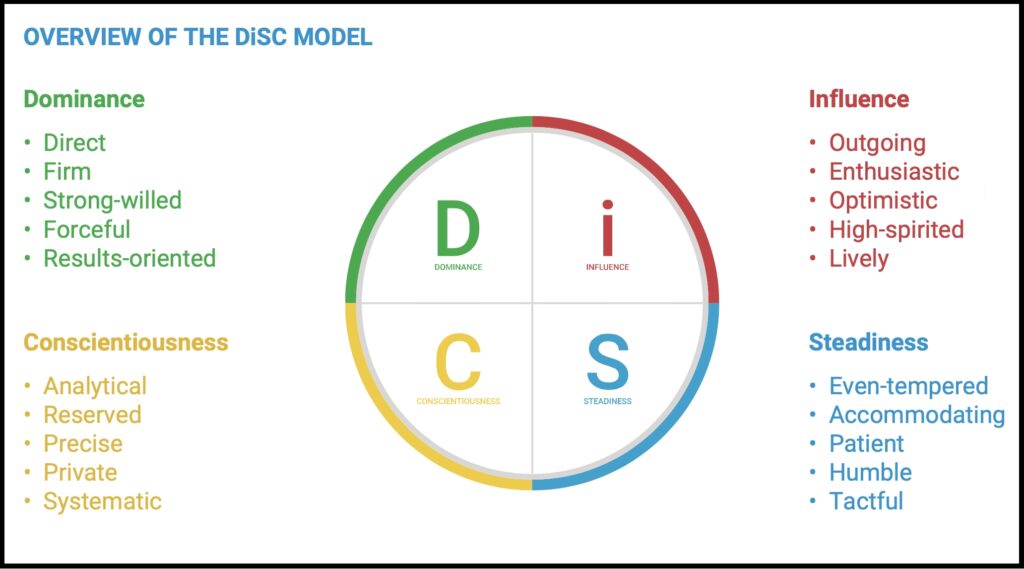
That’s when Nathan discovered DiSC. A DiSC assessment is a powerful tool designed to better understand yourself, your colleagues, and how you interact and work together. DiSC will improve your understanding about how different team members communicate, how they go about working through a problem, and how they prefer to make decisions. The assessment methodology is rigorous, proven, and very dependable. While other worthwhile assessments that look at emotional intelligence and team performance are available, Nathan found DiSC to be perfect for the needs of his team. For example, DiSC helped everyone better understand and appreciate that Rebecca possessed a “D” DiSC-style (see the graphic below). Her preferred style of communication tends to be direct and to the point. She likes a focused, fast pace, and she likes to make decisions quickly. Rebecca is not the sort of person who comes out of a meeting saying, “Did everyone feel heard?” Rebecca is more likely to come out of a meeting saying, “Did we accomplish what we wanted to get done? Are we getting results?” The team recognized that Joshua aligned with a “C” DiSC-style. Joshua prefers logic and analysis. Joshua maintains a look-before-you-leap pace and is comfortable with a methodical, more careful approach. He’s quiet, but he likes to ask a lot of questions and expects clear, precise answers.
This approach offered tremendous value for Nathan and his team. DiSC is a great way to look at who you are and better understand yourself and others — and how everyone interacts and works together. The four “styles” identified in a DiSC assessment are understandable and manageable for people. They are realistic in the sense that they are not part of a rigid formula or framework — people have aspects of other quadrants that shape their style too. Style characteristics and descriptors are pragmatic and resonate in our day-to-day work. DiSC findings are practical and applicable.